

GSSI
Feasibility: GPR works best in resistive conditions like sand, concrete, and fresh water. Where you have highly conductive environments, GPR signals tend to attenuate. Depending on the frequency of the antenna used, you can get 12 inches of data with very high resolution or up to 70 feet with lower resolution. Choosing the correct antenna frequency depends on the scope of your project and site assessment needs.
Design: Before construction on a dam may begin, it is essential to understand the surrounding environment to ensure long-term structural stability. Using low frequency antennas can quickly collect large amounts of very deep data. Users can perform waterbed and bathymetric mapping, identify sub-bottom structures, visualize lithological discontinuities and identify remediation and repair locations. High frequency systems can help determine where any drilling or core may need to take place in a safe environment.
Hazard Assessment: Engineers require specific information about ground conditions before making foundation and structural design decisions. High frequency antennas provide sharp vertical resolution for imaging rebar, small voids and fissures as well as enabling useful slab analysis. This information will be useful to pinpoint questionable locations within the concrete slab or other shallow areas to prevent catastrophic failures. Low frequency antennas can help to identify stratigraphic changes, lithological discontinuities, and sub bottom structures in the dam and reservoir.
Working Life: Safe operation requires that dams are regularly monitored for structural stability. GPR systems are ideal for locating problem areas which may develop over the lifetime of a dam. GSSI’s low frequency antennas can show the interior of large and/or very deep structures to locate large voids, fractures, or leaks. The ability to collect large amounts of data that can be difficult to obtain using invasive methods makes low frequency GPR the go-to for a quick geophysical analysis. Identifying these remediation and repair locations early on means issues can be addressed before they develop into serious problems which could jeopardize the entire structure.
Upgrade/Replacement: GPR is one of the most cost effective and quickest geophysical surveying that can be done on a site. Significant upgrades or even complete replacement of an existing dam may be required as the dam ages and requirements change. GPR can provide a wealth of information to inform the decision-making process in real time.
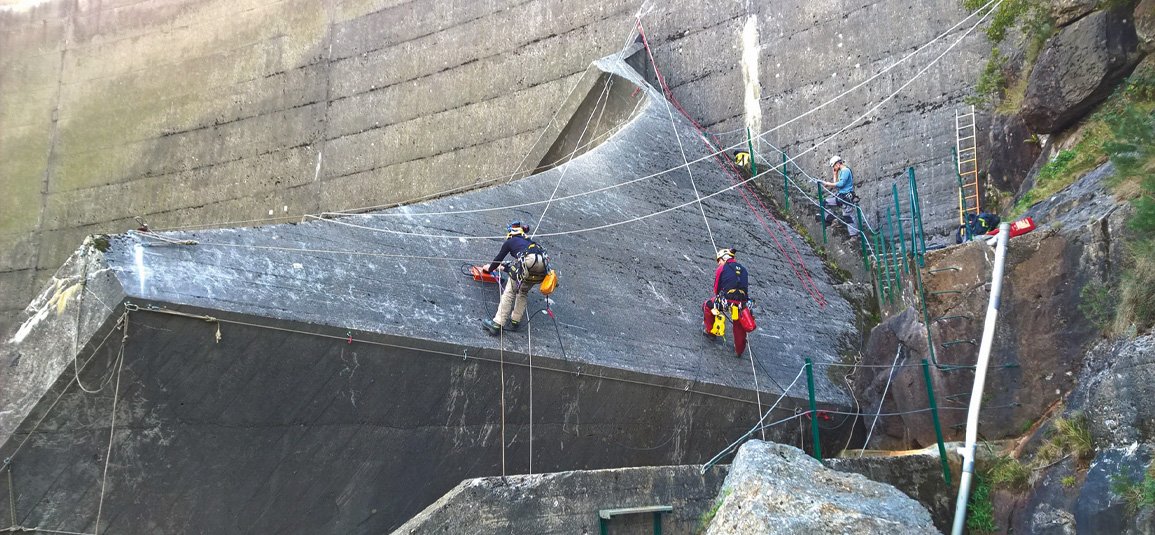
Image shows inspection of dam reinforcement in Lapalisse, France (Image courtesy of ARKOGEOS).