

IRIS INSTRUMENTS
As in many other places all over the world, more than 75% of reservoirs in Taiwan are earth dams. Seepage in an earth dam have to be well monitored to insure the dam’s stability.
Storage is diverted from the Keelung River during rainy periods in typical wet winters and during typhoon storms in the summer, a relative low precipitation season. The dam was first constructed in 1980 but to meet the increasing demand for water supply, the dam crest was raised in 1998 from EL. 75 m to EL. 90 m. Several abnormal leaks appeared on the downstream face of Hsin-Shan reservoir in Taiwan no longer after the dam was reconstructed to raise the maximum reservoir water level. The dam’s administrators preferred non-intrusive geophysical methods for examining the issues.
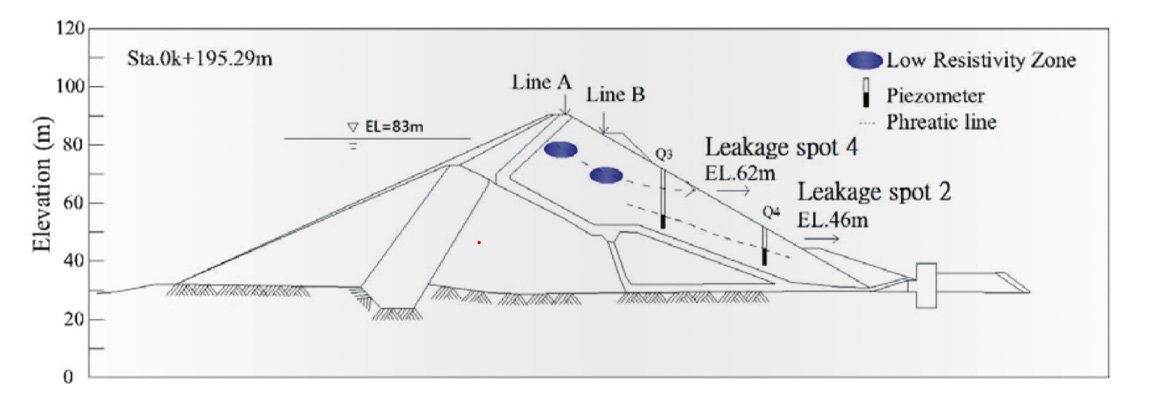
Three 2D ERT profiles were deployed on the abutments, dam crest, and downstream shell of the dam, respectively. Periodic measurements were additionally collected on the downstream shell for time-lapse measurements (line B) for investigating relationships between electrical properties variations and other environmental factors. Combining ERT results with geotechnical monitoring data clearly indicates the likely mechanism of abnormal seepage. Time-lapse measurements further support the inducted mechanism as it monitor water infiltration of unsaturated zone.
Single investigations were used mainly to perceive anomalous seepage in the dam. The time-lapse measurements on line B (closest to the leakage) repeated every months provided additional information by studying the time-variation pattern.
The low resistivity zones and the possible pathways of the anomalous leakage at the downstream face are well above the phreatic line. This indicates that the abnormal leakage is not directly related to the steady-state seepage of the reservoir …more